Episode 125: 5 Ways to Make Better Business Decisions and Stand Out at Work
Sara Murray
Listen on your favorite Podcast Platform:
https://pod.link/1663074741
About
Sara Murray is a sales consultant, trainer, speaker, and host of the Prospecting on Purpose® podcast. She helps sales professionals and business leaders build stronger relationships, prospect with intention, and create pipelines that compound.
Through keynotes, workshops, coaching, and consulting, Sara teaches practical, relationship-first strategies that help people create meaningful connections, add value, and turn conversations into business opportunities.
Learn more about Sara, her work, coaching programs, and speaking engagements HERE.
Watch the episode here
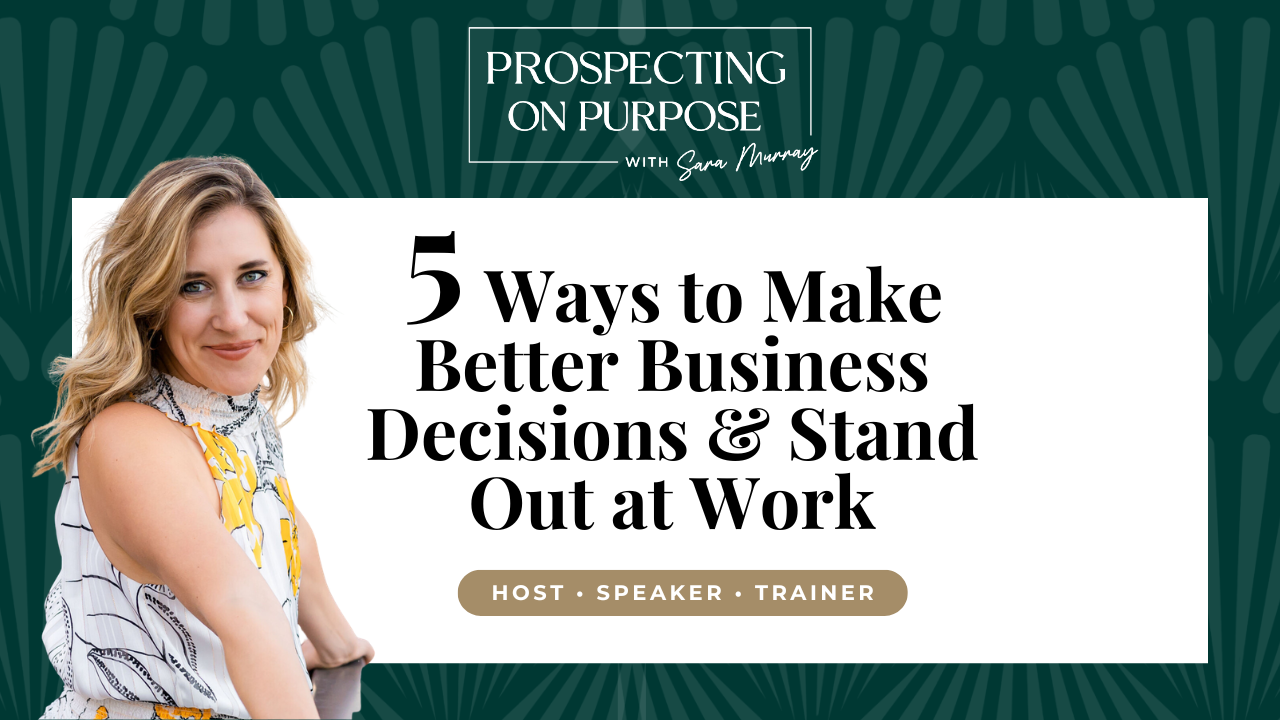
5 Ways to Make Better Business Decisions and Stand Out at Work
What if one of your most useful business tools has nothing to do with a sales script, productivity system, or new technology?
In this solo episode of Prospecting On Purpose®, Sara Murray explores how understanding your core values can help you make better business decisions, increase your confidence, strengthen professional relationships, and differentiate yourself at work.
Sara encourages listeners to think of themselves as their own individual business unit. The way you spend your time, make decisions, communicate, and build relationships all contribute to how others experience working with you.
She shares five specific ways understanding your values can give you a professional advantage, from clarifying your priorities and creating a framework for decision-making to building trust, connecting more effectively with others, and shaping your personal brand.
Sara also shares examples from her own business, including how her values helped her decide whether to renew a client relationship, how you can use values when evaluating a new job opportunity, and how recognizing what another person values can improve a sales conversation.
The episode closes with a simple challenge: identify the five values that matter most to you at work, keep them somewhere visible, and start noticing how often they influence your decisions, relationships, and actions.
What You’ll Learn
In this episode, you’ll learn:
How core values can clarify your professional priorities
Why values can become a framework for better business decisions
How knowing what you stand for can increase confidence
Why values help build trust and integrity in professional relationships
How recognizing another person's values can create stronger connections
How your values influence your personal brand
How to use values when evaluating a client, career opportunity, or difficult decision
A simple exercise for identifying your top five work values
Connect with Sara Murray
Prospecting On Purpose® Podcast - Listen on your favorite Podcast Platform: https://pod.link/1663074741
YouTube: https://www.youtube.com/@saramurraysales
LinkedIn: https://www.linkedin.com/in/saramurraysales/
Instagram: https://www.instagram.com/saramurraysales/
Transcript
Sara Murray - Prospecting On Purpose®
You’re listening to Prospecting On Purpose®, where we discuss all things prospecting, sales, business, and mindset. I’m your host, Sara Murray, a sales champion who’s here to show you that you can be a shark in business and still lead with intentionality and authenticity. Tune in each week as we dive into methods to connect with clients, communicate with confidence, and close the deal.
Hello, and welcome back to Prospecting On Purpose®. My name is Sara Murray, and today we’re going to be talking about one of my favorite topics. The reason this area is my favorite is because this thing we’re going to be discussing is one of the biggest and most powerful tools that you have in your toolbox when it comes to business.
It’s an area that we don’t always spend a lot of time on, so that’s why we’re doing an episode about it. We’re going to talk about why understanding our core values is going to give us leverage when it comes to our business actions. I know when I do this in my workshops sometimes, usually the men are a little bit more grumbly and skeptical about why we’re spending time talking about our values. But by the end of the day, the end of the workshop, this ends up being one of their favorite exercises because it is something that helps us increase our confidence, show up more authentically, and really be thoughtful and intentional about how we connect with others in a business environment.
When people think of values and principles, oftentimes they relate them to an organization or a company. What are the company’s values? It might be a webpage. It might be signage up in the office. I think this is fantastic when businesses do this, and in my experience, a lot of them actually do work in alignment with their values and use them in the right way. If you don’t know your organization’s values or principles, I encourage you to look them up. And if you don’t have values or principles, I encourage you to create some for your business.
But what I find to be an interesting differentiator for success, and this is what I teach in my workshops, is that every single person is their own individual business unit. The way you spend your time, the way you spend your money, the actions that you take, all of that is really business decisions, usually in alignment with the larger organization’s goals. But if we can start looking at ourselves as our own individual business unit, that’s going to help us differentiate ourselves from other people and give us a competitive edge.
When we think about starting with our core values, one caveat I want to make is that we’re allowed to have values that are different in different areas of our lives. The way that you show up as a spouse or a parent or a daughter or a sibling might look very different than how you show up at work. You might really value loyalty in your relationship, but loyalty might not be a core value at work. Today, I want you to view everything we’re talking about through a business lens, a work lens.
There are five really specific business reasons why understanding your values is going to help you get ahead and why this matters. The first is that it clarifies your priorities, which also helps you clarify where you spend your time.
The second, and probably one of the most important, is that understanding our values gives us a framework for our decision-making. If we are making decisions that are out of alignment with our values, that becomes a clear line in the sand for us to say, ‘Oh, this actually isn’t the right action I should be taking.’ It’s important to have that tool because it helps us make decisions, but it also helps us be more confident in the decisions that we make because they’re in alignment with our values.
From a business standpoint, understanding your values also helps you build trust and integrity in relationships because you’re showing up representing your values, and other people feel that and see that.
It’s also going to help you recognize other people’s values, which leads to the fourth reason why this is important. Understanding our values helps us create quick connection points with other people, which is really key in any business environment, especially sales. We want to find connection points. We want to build relationships because that’s how we sell things. That’s how we influence others to want to work with us. People work with who they know, like, and trust. If we know ourselves, we like ourselves, and we trust ourselves, that’s going to come through. The way we do this is by spending some time understanding ourselves.
The fifth piece is that it really helps shape your personal brand. In 2026, in the world of AI and digital noise and all the messiness that’s out there, having a personal brand is actually a strategic professional advantage. Core values are an element of your personal brand.
So those are the five reasons: clarify priorities, serve as a framework for decision-making, build trust and integrity, quickly create connection points, and shape your personal brand.
I’m going to go through a list of values, not a huge list. I’ll probably read about 12. What I want you to think through is which ones are resonating with you more. If you hear one and think, ‘Yes, that’s me,’ great. If you hear one and think, ‘Nope, I don’t care about fame. I don’t care about power,’ great. Process of elimination. That’s not one of your core values.
The second thing I want you to think about, especially with your personal brand, is one definition I use for that: What do people say about you when you’re not in the room? When I think about my own personal values at work, I’ll share mine: professional, fun, creative, approachable, and intentional. Those are my five core values at work.
A lot of times people will say, ‘Wow, you’re so intentional. You’re really intentional with your actions. You’re intentional with your business.’ That’s one of the biggest compliments that someone could pay me because it means my values are showing up at work.
I’m going to read this list to you. Again, think about what resonates with you, and think about what you want people to say about you when you’re not in the room. There are hundreds and hundreds of values. There’s a website where I found a great list, scienceofpeople.com/core-values, if you want to spend some time looking at this longer. I’m just going to read off a few and see which ones stand out more: honest, creative, loyal, ethical, integrity, trust, compassion, courage, passion, creativity, leadership, adaptability, transparency, dependable, innovative.
Okay, how did that feel? Did anything stand out?
One of the things I want to talk a little bit more about is this concept of using our values for decision-making. I’ll share a quick example. About a year and a half into my business, I had a client I was working with, and I didn’t love working with them. There was nothing bad about them or their organization, but some of the stuff that they did just made me feel a little icky. It just didn’t sit right.
Our contract was up, and they wanted to renew and keep working together, and I wasn’t sure if I wanted to. So I did what everyone does when they need to make a hard decision, and I made a pros and cons list. At one point, writing the cons, I just wrote, ‘They’re not in alignment with my values.’ As soon as I realized that, as soon as I put pen to paper and saw that, it was the clearest no ever.
We did not renew the contract, and I felt really good about it because I used that as a framework for decision-making. I see organizations use this a lot, too. If they can empower their people to really understand the values of the business and then act within those values for the business, any action they take is going to be backed up by the company because they were acting with the company’s core values. It’s the same for us. It serves as a great decision-making tool. I use my values all the time as a gut check to see if it’s a yes or a no, or which path I should take.
I’ll give one more example. Let’s say you have a job opportunity for a new job, and you’re not sure if you want it. You’re not unhappy with your current employer, but you had a headhunter reach out, you interviewed anyway, and now you’ve got an offer. You have two choices to make: Do you stay at your current employer, or do you take the new job?
One thing you could do is look at both companies’ principles and both companies’ values and compare them to yours. Which ones feel more in sync, and which one doesn’t? That’s just another data point for you in decision-making.
The other piece that I really, really like about understanding our values is the ability to build connections with others. Let’s say I prioritize fun or creativity, and I meet somebody else who also prioritizes fun and creativity. Our working relationship is going to be super easy because we already have something in common. We already have that foundation laid.
But what happens when you don’t have shared values with someone else? What happens if you’re meeting with someone and they don’t value what you value? When we are in a position where we’re selling something or we’re influencing others, one way that we can use this tool is to look at what that person stands for. How are they showing up with their words and actions?
I’ll share another example. Early on in my business, I had a meeting with a company I was trying to sell sales training to, and one of the men in the meeting was very pointed and direct in his questioning. I was a new business, so I didn’t have a ton of social proof outside of my own success and some anecdotal success. He was being very direct, but respectful. Even though he was hitting me with objections, I like objections, so I wasn’t afraid of it. He was kind, respectful, professional, and just very direct.
I also value professionalism, so I mirrored back and answered his questions respectfully, honestly, and directly because it was very obvious to me that he valued respect and directness. What was funny is that at the end of the meeting he said, ‘Well, thank you so much for letting me ask you all my questions. I hope you found me respectful.’ It was so funny because I did, and I figured it out before he told me.
Most of the time people aren’t going to tell you, but you can use context clues. Once you start to use these out in the world, you’re going to find that they show up all the time.
As an action item today, I want you to sit with your core values. Visit a website, ask AI for a list of values, and pick the top five that resonate with you the most at work. Put them on a Post-it Note, stick it near your computer, and see how often they show up during your day. You will be shocked at how much you can use them.
Just to recap, our five business reasons are: clarification on your priorities, a framework for decision-making, building trust and integrity in relationships, quickly building connection points with others, and helping shape your personal brand.
I think one of the things that’s most powerful about this is that it really helps us show up with confidence. When we think about confidence, I like to marry confidence with authenticity because if we have self-worth, self-awareness, and self-love, that’s going to show up as authentic, which helps us show up as confident.
But if we don’t take the time to build relationships with ourselves and reflect on ourselves, then we miss that opportunity to have that confident advantage. I really hope you got value out of today’s episode. It is a really interesting area to sit with and think about, so I hope you take the time to sit with it.
If you enjoyed this episode, please leave a review, subscribe, share, all the things. Thanks so much for joining, and I’ll see you next week.
Thank you so much for listening to the Prospecting On Purpose® podcast. If you loved what you heard today, subscribe to the podcast and please rate and leave a review. For more info on me, or if you’d like to work together, feel free to go to my website, saramurray.com. On social media, I’m usually hanging out @saramurraysales.
Thanks again for joining me, and I’ll see you next time.
Related Episodes
Increase Your Executive Presence with Melissa Maher
Good connection to confidence, visibility, personal brand, and how others perceive you. The episode is currently listed as Episode 120 on Sara's podcast page.
https://www.saramurray.com/podcast/prospecting-on-purpose-increase-your-executive-presence-melissa-maher
Becoming Unshakable in Leadership and Life with Lovell Casiero
Good connection to authenticity, self-awareness, confidence, mindset, and professional growth.
https://www.saramurray.com/podcast/prospecting-on-purpose-becoming-unshakable-leadership-life-lovell-casiero
How to Stand Out in Business by Doing What Most People Don’t with Bart Berkey
Probably the strongest related episode for this particular page because both focus on differentiating yourself professionally through how you show up and connect with people. Sara's podcast index currently lists it as Episode 123.
https://www.saramurray.com/podcast/prospecting-on-purpose-how-to-stand-out-in-business-bart-berkey
Connect with Sara Murray
Prospecting On Purpose® Podcast - Listen on your favorite Podcast Platform: https://pod.link/1663074741
YouTube: https://www.youtube.com/@saramurraysales
LinkedIn: https://www.linkedin.com/in/saramurraysales/
Instagram: https://www.instagram.com/saramurraysales/