
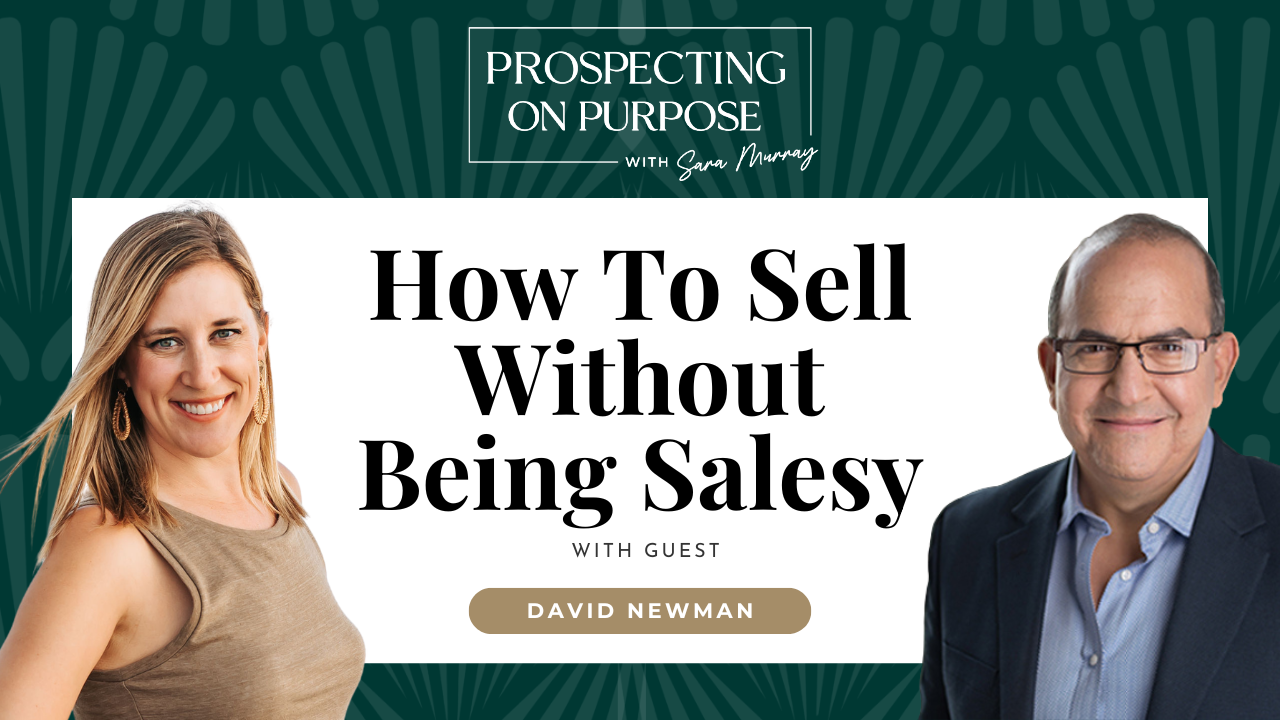
Episode 121: How to Sell Without Being Salesy with David Newman
David Newman

David Newman is a professional services sales expert, speaker, bestselling author, and the founder and CEO of Do It! Marketing®.
A Certified Speaking Professional and member of the NSA Million Dollar Speakers Group, David helps consultants, coaches, speakers, and professional service providers land better clients, close bigger deals, and earn higher fees.
He is the author of the bestselling books Do It! Marketing, Do It! Speaking, and Do It! Selling, which provide practical, immediately actionable strategies for marketing, prospecting, selling, and growing a service-based business.
David is also the creator of the Do It! MBA Mentorship and the host of The Selling Show, where he shares strategies for building trust, attracting premium clients, and selling from a place of authenticity, curiosity, and service.
Watch the episode here
Selling does not have to feel pushy, uncomfortable, or transactional.
In this episode of Prospecting On Purpose®, Sara sits down with professional services sales expert and bestselling author David Newman to explore how to build trust, reduce buyer pressure, and sell without sounding salesy.
David explains why a seller’s most important job is not to close the deal. It is to show the buyer that you understand what they are experiencing and that you can help them solve it.
They discuss how to create a safe buying environment, ask stronger discovery questions, become unignorable to decision-makers, and target the ambitious companies most willing to invest. David also shares why most closing problems actually begin much earlier in the sales process and how enthusiasm, authenticity, and genuine service can make selling feel more natural.
If you want to prospect with more confidence, build stronger relationships, and close bigger opportunities without relying on pressure or scripted tactics, this episode is for you.
Sara Murray - Prospecting On Purpose®
You’re listening to Prospecting On Purpose®, where we discuss all things prospecting, sales, business, and mindset. I’m your host, Sara Murray, a sales champion who’s here to show you that you can be a shark in business and still lead with intentionality and authenticity.
Tune in each week as we dive into methods to connect with clients, communicate with confidence, and close the deal.
Welcome to Prospecting On Purpose®. I am thrilled to have our next guest on the air.
David Newman is a professional services sales expert who works with leading consultants, coaches, and speakers who want to land better clients, bigger deals, and higher fees. David is the author of the number one business bestseller, Do It! Marketing. He is the creator of the Do It! MBA Mentorship and the host of the highly rated podcast The Selling Show.
He is also the author of a book we are going to talk about today called Do It! Selling.
David, welcome to Prospecting On Purpose®.
David Newman
Thank you, Sara. It's great to be here.
Sara Murray - Prospecting On Purpose®
I’m so excited for our conversation today because so much of what you discuss on your podcast, with your clients, and in your book is about confidence in selling and giving people the tools to feel confident in their sales efforts.
I think that’s why you’re a perfect guest for our audience. Let’s start with your journey and how you found yourself becoming a sales guru.
David Newman
Sure. I’m probably the least likely sales guru.
It’s funny because many of our colleagues work in sales coaching and sales training, but I’m the last person I ever thought would end up in sales.
I spent 10 years working for large management and technology consulting firms. In 2002, I went out on my own and thought, “I know how to speak. I know how to coach. I know how to train. How hard can it be?”
Sara, I found out exactly how hard it could be because I had no idea about marketing, sales, or any of the things we’re going to discuss today. I thought, “I’m great at doing the work.”
But when you’re an entrepreneur, it isn’t only about doing the work. It’s about selling the work.
I immediately realized I was totally hopeless at it, so I hired a sales coach. He was a great coach and is still a friend to this day. He also held a monthly in-person class for his local clients.
I went to the first class, and the topic happened to be prospecting. The very first words out of his mouth were, “So, you’re talking to a prospect, and it’s really important that…”
The imaginary music came up, the camera went blurry, and I was already lost. Internally, I felt like raising my hand and saying, “Excuse me, sir, these prospects of which you speak, how do you find them?”
Sara Murray - Prospecting On Purpose®
Who are they? How do I get them?
David Newman
You’re assuming I’m already talking to a prospect, and I have no idea how to even get a conversation going.
That’s where we started, my friend. I hit every brick wall and every dead end. I made all the mistakes in the sales and prospecting book. I probably made the good ones twice because they were so much fun.
Eventually, I figured some things out. I read a ton of books, went to classes, and invested in sales coaching and training.
At the time, a lot of sales coaching and training was aimed at local or product-based businesses. There were roofers, plumbers, water-purification companies, and all kinds of businesses that didn’t completely fit what I was doing.
There were also the big sales-training franchises, such as Sandler, Miller Heiman, and SPIN Selling. I couldn’t completely embrace any one of them, so I put together my own playbook.
I started closing significant training contracts with Fortune 500 companies. Then my friends and peers, including other consultants and trainers, began asking, “David, can I pick your brain? Can we have breakfast, coffee, or drinks? I’d love to find out how you’re doing this.”
I had no problem meeting with good people who were asking good questions.
During one of those breakfasts, a consultant friend put down his fork in the middle of our bacon and eggs and said, “You are so good at this. You should do this for a living.”
This was about five years into my journey. I said, “Do what for a living? Eat breakfast with people?”
He said, “No. Teach people what you know about landing these big Fortune 500 contracts.”
Sara, I laughed at him. I said, “That’s a ridiculous idea. People like you and me, solo entrepreneurs and small-business owners, are broke and hopeless. Thanks, but no thanks. I’m going to keep selling my big contracts.”
Finally, he said, “I want you to teach me what you know. I will pay you. What will it cost to hire you as a coach?”
Because I had been selling $10,000, $20,000, and $30,000 deals, I had never priced one-on-one coaching. I asked, “How much do you charge your clients?”
He said, “$125 an hour.”
I said, “Great. I’ll coach you for $125 an hour.”
That was the seed. It was version 0.1 of where we are today.
Sara Murray - Prospecting On Purpose®
I think about all the challenges you described along that journey: not knowing who a prospect is, how to reach them, how to open the door, or having friends ask, “How are you doing this?”
I think that is universal. Everyone, regardless of their role, has to sell in some form.
David Newman
Yeah.
Sara Murray - Prospecting On Purpose®
What I find interesting about sales is that everyone has to do it because all of business involves influencing others. That is really what sales is.
But it needs to come from a place of authenticity and genuine care. I think people become nervous about sales because they don’t want to seem salesy or icky, so they shy away from it.
What eventually helped you overcome the fear of selling? What was the moment when it began to click?
David Newman
I think there is still a major adversarial assumption in sales.
Think about the words we use. We talk about targets, prospects, and being in a target-rich environment when speaking at a conference or attending a networking group.
We have to qualify, filter, fish where the fish are, catch the fish, reel them into the boat, kill the fish, and eat the fish.
Sara Murray - Prospecting On Purpose®
Hunters, farmers, kill the elephant.
David Newman
Exactly right.
Sara Murray - Prospecting On Purpose®
I am guilty of using all those words.
David Newman
All of those terms assume either a predatory or adversarial relationship. I had to let all of that go.
Sara Murray - Prospecting On Purpose®
Hmm.
David Newman
First, it took my prospecting activity down to zero because I chose not to engage in that messy, goofy, toxic dynamic.
By the way, zero prospecting is not a good strategy for anyone listening.
Sara Murray - Prospecting On Purpose®
I’m pretty sure there’s a quote in David’s book that says, “No customers equals no business.”
David Newman
And no bueno is the final touch on that.
The whole “I’m out to get them” mindset is the problem. We think, “I have to close them,” and create all this pressure. Sometimes we put that pressure on ourselves.
I realized my main job is to communicate two and only two things in everything I do: online, offline, in person, while networking, during initial prospect conversations, on phone calls, and on Zoom calls.
First, I understand what you’re going through. Through thoughtful questions, I can diagnose the situation and understand what you’re experiencing.
Second, I can fix it or I can help.
If you let go of the pressure to close them, put them through your sales process, move the ball forward, and gain commitment, your only two jobs in marketing, sales, and business development become clear.
Through every post, blog, phone call, introduction, and referral, communicate:
1. I understand, or I am committed to understanding, what you’re going through. 2. I can help you fix it.
People immediately resonate with where you’re coming from.
Sara Murray - Prospecting On Purpose®
Mm-hmm.
David Newman
I have found that you can have the world’s best sales script, and I am very much against scripting.
I strongly support preparation and structure, but I am against scripting because you can have the world’s most perfect script while thinking, “I have to close the sale. I have to close the sale.”
That feels hungry and desperate. It gives off sales breath.
Sara Murray - Prospecting On Purpose®
Transactional. Yeah.
David Newman
Exactly. It’s transactional. It’s like a dog going after red meat.
The world’s best sales script will not save you. But if the person can feel that you are there with care, concern, curiosity, and a genuine desire to help them, even if you are only helping them see their problem more clearly, that matters.
It doesn’t matter how much you stutter, stumble, forget something you wanted to say, or miss a question you intended to ask. People are smart. They have an invisible radar.
A person with a flawless script and hostile intentions will never do as well as somebody with genuine intentions, even if that person’s script is imperfect, scrambled, or nonexistent.
I’m not saying you should be sloppy or unintentional with your sales conversations. Those things are important. But your intentions have to come first.
The turning point was realizing that where I’m coming from is far more important than my technique.
I’ve had sales conversations that I thought were fantastic, and the prospect ended by saying, “Wow, David, you are a really good salesperson.” They didn’t buy because my technique was showing.
I’ve also had conversations where people bought almost effortlessly and nobody complimented my sales skills.
If someone compliments you on your sales skills, it can almost be the kiss of death. They feel that something is being done to them. They’re thinking, “You’re a really good technician, but I’m not going to buy.”
The invisible sale is based on genuine trust, rapport, respect, and the feeling that this person wants you to do better and that buying will help you do better than not buying.
The seller creates the environment for that transformation to happen in the buyer’s mind. The sale happens in the buyer’s mind. We don’t do it to them, and we can’t force it. We simply create an environment where it can happen more easily.
Sara Murray - Prospecting On Purpose®
I call it ABAV: Always Be Adding Value™.
David Newman
Yes.
Sara Murray - Prospecting On Purpose®
That applies to anyone you interact with because prospecting happens everywhere. It happens on a chairlift while you’re skiing.
David Newman
Yeah.
Sara Murray - Prospecting On Purpose®
I got a lead the other day at my apartment community pool.
David Newman
Yeah.
Sara Murray - Prospecting On Purpose®
It came after I had been adding value to the person.
I think we assume we always have to be “on,” but as you said, people’s BS meters are finely tuned.
David Newman
Very much.
Sara Murray - Prospecting On Purpose®
When you approach the conversation by asking, “How can I add value?” you set the stage for success.
I like how you phrased it, David. You make the other person feel comfortable and safe, like they are not being sold to.
David Newman
Yeah.
Sara Murray - Prospecting On Purpose®
They think, “This person wants to help me.”
David Newman
Yeah.
Sara Murray - Prospecting On Purpose®
That might mean they don’t buy from you because you may not have the right solution. But people sense that sincerity.
David Newman
Yeah.
Sara Murray - Prospecting On Purpose®
What are some of the biggest…
David Newman
I think another…
Sara Murray - Prospecting On Purpose®
Oh, go ahead.
David Newman
Another important piece of prospecting dialogue that I discuss in Do It! Selling is conditional language.
For example, if you and I are having a conversation, I might say, “Whether this ends up being a good fit for us to work together or not…”
The phrase “or not” opens the door. It acts like a pressure valve.
During an initial prospecting conversation, I might say, “Sara, this may be the very last time we ever speak one-on-one. The gaps I see in your business are number one, number two, and number three. If you could fix those three things…”
Sara Murray - Prospecting On Purpose®
That's good.
David Newman
“…either with my help, someone else’s help, or on your own.”
At every opportunity, I am adding value and releasing pressure. I am creating a safe buying environment.
As you said, people’s BS meters are set to supersonic. Buyer safety means people do not feel pressured or manipulated.
When I say, “These are the three areas I see that you need to fix. I can help you, someone else can help you, or you can fix them on your own,” most people think, “He diagnosed this precisely and identified three blind spots. Why would I hire anyone else?”
Sara Murray - Prospecting On Purpose®
Totally.
David Newman
People are lazy, busy, and befuddled.
If they are talking to Sara Murray and Sara has presented herself as the obvious choice, they think, “The shortest path between me and results is to hire Sara.”
Sara Murray - Prospecting On Purpose®
Totally. Something you said that really stands out to me is the concept of buyer safety.
I also think that when the seller adds “or not,” it helps the seller relax too. I don’t need to jump into pricing or pitches. I’m simply asking questions and identifying areas where I may be able to help.
I experienced this yesterday with a client I love working with. We want to extend our contract, but I started by saying, “I’m not ready to talk numbers today because I don’t know what you need.”
It helped me relax, and it became a conversation. Now I can see where we may continue working together.
That is very different from buyer-seller transactional ickiness.
We need to help people understand that this is simply a conversation and that we are trying to add value. If you approach it with desperation or pressure to hit a number, people will smell it, and it won’t be enjoyable for either party.
David Newman
I’m sure you’ve had this conversation about prospecting.
I have longtime clients who say, “David, I have a brand-new meeting on my calendar next Wednesday. Do I go in and pitch A, B, or C?”
Because they are longtime clients, I look at the screen and say, “I’m sorry. Could you repeat the question?”
They say, “I have a sales meeting on Wednesday. Do I pitch…”
Then they remember, “Oh, that’s right. We don’t pitch anything. I go in unarmed?”
Exactly. You go in unarmed. You bring care, concern, curiosity, questions, and a questioning plan.
In Do It! Selling, I say you need to approach this like a courtroom attorney preparing for cross-examination. You need to gather the facts before you are ready to argue anything.
You can’t begin with, “Buy my solution.”
You need to understand what is happening with the person, their team, their company, their revenue, and whatever problem you are trying to solve.
I may have 17 questions to ask before I’m ready to pitch anything.
David Newman
Let’s say someone has binged all your content, listened to every Sara Murray podcast episode, and arrives on the call saying, “Sara, you don’t need to pitch me. I’m in. Sign me up.”
Even when someone is essentially handing me a credit card, I often say, “I appreciate that so much. It’s a huge compliment. Thank you. But I have to be brutally frank. We’re not there yet.”
I slow down the sales process because I genuinely don’t know whether they are a good fit, whether I can move the needle, or whether I can help them achieve the results they want.
That is another magic phrase.
When someone is two-thirds of the way through a sales conversation and says, “Send me a proposal. This sounds perfect. We have a $50,000 budget and are ready to go,” I may respond:
“Thank you. I really appreciate that. That is clearly a positive green-light sign, but we’re not there yet. Do you mind if I ask a few more questions about your exact situation and goals?”
When you slow the process down, does trust go up or down?
Trust goes up 100 percent of the time.
Sara Murray - Prospecting On Purpose®
Exactly. As you’re talking through the questioning process, a major part of it is building trust.
In most B2B environments, and B2C too, it usually isn’t a one-person decision.
David Newman
Amen.
Sara Murray - Prospecting On Purpose®
Oftentimes, especially when you work with organizations that have multiple decision-makers, you need to earn enough trust to reach the next part of the selling process.
My background was in the architecture and construction market. I might have a meeting with the architect, but I really wanted a meeting with the end user who would sign the check.
That architect was not going to introduce me to their client unless they trusted me.
If you go in with what I call product vomit…
David Newman
Yes.
Sara Murray - Prospecting On Purpose®
…dumping a bunch of product information and talking numbers, that trust never gets built. They are not going to put you in front of their client.
There may also be a boss who has to give sign-off or other departments and decision-makers who need to become involved.
The beginning of the sales process is about whether they like and trust you.
David Newman
Yeah.
Sara Murray - Prospecting On Purpose®
That takes a lot of pressure off.
I only need this person to see that I add value, that I care, and that I’m trustworthy. Then we can start discussing numbers.
By the time it is appropriate to discuss numbers, the buyer may already be thinking, “Why wouldn’t I work with David? He knows everything about me. He understands my pain points.”
David Newman
Right.
Sara Murray - Prospecting On Purpose®
The closing becomes very organic. If you get the beginning right, the closing is much easier.
David Newman
Absolutely.
People say, “I’m having great meetings. My pipeline is stronger than ever, but I’m not closing deals. I must have a closing problem.”
Ninety-nine percent of the time, in my experience, it is not a closing problem. It is an opening problem. It is how the conversation started, or something that happened in the middle.
Good prospects will close themselves.
Sara Murray - Prospecting On Purpose®
Right.
David Newman
After thousands and thousands of sales calls, I can personally attest that good clients will close themselves.
You don’t have a closing problem. You have a…
Sara Murray - Prospecting On Purpose®
Prospecting problem.
David Newman
A discovery problem.
You didn’t ask the right questions, reflect the right things, or surface the issues behind the issues and the problems behind the problems.
It may sound like you have a strong pipeline and a series of good conversations, but the reason for a failure to close usually appears much earlier in the sales process than you think.
Sara Murray - Prospecting On Purpose®
When I started my business, I named the podcast Prospecting On Purpose® because when something goes wrong at the end, the beginning is often where the process went off track.
David Newman
Yes.
Sara Murray - Prospecting On Purpose®
What can be challenging for people to understand is that the beginning of the prospecting process is about relationships.
People think they need hard skills such as negotiation or confidence during crucial conversations. But if you handle the beginning well, it is really about being a real human.
Take the salesmanship out of it. Be real, be cool, and the rest becomes easier.
What I really liked about your book was the specific language and tactics you shared.
One idea I am going to start using in my business is “Be Unignorable.” You offered interesting tactics for approaching prospects in a way that makes you difficult to ignore.
Would you share some of those tips with the audience?
David Newman
A lot of times, we prospect one-on-one. You identify a single prospect or decision-maker with a logical title, such as a C-suite executive or vice president, and decide that person must be your target.
But most complex, high-dollar B2B sales involve multiple decision-makers.
The strategy is simple: Don’t target one decision-maker. Target three.
When you contact three people, tell each one that you also contacted the other two.
If you are the CEO, I might send you a note saying:
“Sara, I saw that you were recently promoted and that your company received a new round of funding. Here is how we have helped clients in this exact situation.
I also contacted Deborah and Sam separately because I know they may be involved. Would it make sense for us to put our heads together and have a conversation?”
Now Sara receives the note and thinks, “He already contacted Deborah and Sam.”
She may go to Slack and ask, “Did this David Newman character contact you?”
They say, “Yes, I received the same note. Should we spend five minutes discussing this during our next team meeting?”
Now I’m unignorable because I have become a topic of conversation among three top executives.
None of them will immediately say no because one of the others may want it.
Sara Murray - Prospecting On Purpose®
I know. That’s why I think it is so brilliant.
Standing out in people’s inboxes is incredibly difficult.
David Newman
Yes.
Sara Murray - Prospecting On Purpose®
I usually delete emails from people I don’t know without even reading them.
If you send the message to three different people, you triple the chances that someone will actually read it.
David Newman
Also true. Yes.
Sara Murray - Prospecting On Purpose®
I think it’s clever. What results have you seen from this approach?
David Newman
You definitely get a bump in response rate.
Sara Murray - Prospecting On Purpose®
Mm-hmm.
David Newman
Sometimes the response comes from the person you expected.
But this is an evergreen sales problem: The title does not always identify the real decision-maker.
Someone may respond, “I’m glad you sent that to me because this is actually my department.”
You may usually sell to CMOs, but perhaps you also contacted the chief operating officer, and this happens to be that person’s number one priority for the next 12 months.
You didn’t know that going in, but you increased your chances by contacting three or four people instead of one.
Sara Murray - Prospecting On Purpose®
We can’t make assumptions. I see people doing that frequently in my work.
For the most part, I don’t make assumptions. It was a good habit I developed at a young age, but I didn’t recognize its value until I started seeing the opposite habit in others.
I once had a meeting for the first client of my consulting firm. We were going to pitch someone with a particular title.
The two founders had brought me in because they weren’t comfortable with sales. I told them, “I know someone who uses the product. I asked what she likes about it, and she sent me a long list. I’m going to open the meeting by sharing that.”
They said, “No, Sara. He won’t care about that. He’s the product guy.”
I said, “You need to trust me. This is what she likes. Just watch.”
I opened the meeting by telling the prospect, “One of my friends uses your app, and here is what she told me.”
I read her message verbatim, and you could see the energy shift. He became excited because all the features she liked were his brainchildren. They were ideas he had developed before taking on the vice president of product-management role.
David Newman
Nice.
Sara Murray - Prospecting On Purpose®
The conversation completely shifted. Both founders were texting me, “You were right.”
The point is that we simply can’t assume.
Navigating organizational structures and decision-making can consume time we don’t have. I love this strategy because it respects multiple decision-makers, casts a wider net, and triples your opportunities for a response.
It’s brilliant.
David Newman
Thank you. Use it in good health.
Sara Murray - Prospecting On Purpose®
Thank you.
Another concept I liked in the book was selling to the top.
David Newman
Yes.
Sara Murray - Prospecting On Purpose®
I want to discuss that. What does selling to the top mean to you?
David Newman
It means a couple of things.
Most people say to sell high. If you are targeting the C-suite, go to the CEO. If you are targeting vice presidents, go to senior or executive vice presidents.
Selling to the highest job title is part of it, but I also encourage people to sell to the best of the best in their target market.
Sara Murray - Prospecting On Purpose®
Hmm.
David Newman
One of my mantras is, “The best of the best are the ones who invest.”
Think about the laggards, average performers, and elite high performers.
If you are selling significant five-, six-, seven-, or even eight-figure B2B deals, you may assume that market-leading prospects already have everything handled. You may think they don’t need your solution, software, or service.
But how did the best companies become leaders in their market?
They invested in their people, processes, technology, consultants, and the best product and service providers.
These companies respond to language such as:
“Move ahead.” “Stay ahead.” “Get ahead even faster.”
They are already the number one, two, or three players in their market. When you speak the language of ambition instead of the language of struggle or…
Sara Murray - Prospecting On Purpose®
Lack.
David Newman
…getting back up the ladder, which is what B and C players may be wrestling with, you create a premium value proposition.
You get the attention of decision-makers at the top and position yourself as a premium provider because only a premium provider would approach a market-leading company about a significant problem.
I recently posted a LinkedIn article about champagne problems.
Strugglers have problems. Average performers have problems. Elite performers also have problems.
We often sell to strugglers because we think, “They really need what I do. They’re in terrible shape. Even a 20 percent improvement would make a major difference.”
But strugglers often don’t invest.
Elite companies respond to champagne problems, first-world problems, or elite problems. Those problems may be even more urgent because A players cannot afford to let any part of their operation perform at a B or C level.
Sara Murray - Prospecting On Purpose®
They have to defend the hill they’re standing on.
David Newman
Exactly.
Sara Murray - Prospecting On Purpose®
And how do they defend that hill?
David Newman
They know there is a lean, innovative upstart nipping at their heels and preparing to eat their lunch.
When you use a message such as “Get ahead, stay ahead, and move ahead faster,” they respond.
You will get more meetings with bigger and better companies for bigger, juicier opportunities.
Those companies may be harder to reach initially, but once you get in, they often buy faster and buy bigger.
Sara Murray - Prospecting On Purpose®
I love this because I think I was doing it without realizing it.
When I look at my current client mix, they are innovators in their industries. They are the best of the best, and I hadn’t connected those dots.
My background has always involved selling luxury and best-in-class products. I would never want to sell the cheapest thing because who wants to race to the bottom on price?
You have to sell value and understand the business model. That is what creates trusting, consultative partnerships.
Reading, “The best of the best are the ones who invest,” connected a lot of dots for me.
Your point about confidence also matters. When you reach out to A players in an industry, it says something about you.
I sell salesmanship and sales programs, so I can’t be afraid to reach out to those companies. It may be nerve-racking, but it demonstrates what I’m going to teach their teams to do.
David Newman
Exactly right.
Sara Murray - Prospecting On Purpose®
Be confident when selling to the top. Regardless of someone’s title, if you are adding value, that is how you do it.
I thought that was powerful.
What are some habits top-performing sales professionals consistently practice?
David Newman
One important habit, especially when discussing prospecting, is putting fresh targets on your radar every day.
Sara Murray - Prospecting On Purpose®
Hmm.
David Newman
Every day.
Sometimes we are managing a pipeline or a long, complex sale. We may be on step 17 with one prospect and step 32 with another.
We neglect to add fresh prospects to the pipeline, but tomorrow’s step 17 started as today’s step one.
How consistently are you refilling and refreshing your pipeline?
Another important habit is expressing gratitude.
Sara Murray - Prospecting On Purpose®
Mm-hmm.
David Newman
Express gratitude to your team, colleagues, current clients, and past clients.
Sometimes people say you need to meditate and feel grateful while sitting alone in your office. That is nice, but unexpressed gratitude is unrealized revenue.
When you send a thank-you note, write a text, or comment on someone’s LinkedIn post, they may respond:
“Sara, it’s funny you sent this today. We were just discussing our sales team. You and I should talk.”
Or:
“I saw your kind comment on my LinkedIn post. Long time, no chat. We’re fine, but I was just speaking with someone I need to introduce you to.”
Take every opportunity to express gratitude, but don’t manufacture it. We feel genuine gratitude for genuinely good people in our lives.
Sara Murray - Prospecting On Purpose®
Sincere. Sincerity is key.
David Newman
It has to be sincere and authentic, but unexpressed gratitude is unrealized revenue.
Sara Murray - Prospecting On Purpose®
I love that because it connects to ABAV: Always Be Adding Value™.
People sometimes view those activities as non-revenue-generating, but they are the opposite. As you said, it is untapped revenue.
I recently noticed on LinkedIn that someone had started a new job. I sent her a note saying, “I didn’t realize. Congratulations, and best of luck in your new role.”
She wrote back, “We need to talk. My team needs your help.”
I thought, “Great.”
David Newman
Exactly.
Sara Murray - Prospecting On Purpose®
But that wasn’t why I sent the note.
We need to practice a discipline of gratitude. I love that.
David Newman
Yes, absolutely.
Sara Murray - Prospecting On Purpose®
The book is Do It! Selling. It was digestible, tactical, and full of useful tips.
I loved “Be Unignorable,” and I thought the idea of going right to the top was brilliant.
You also have another book coming out. What is it about?
David Newman
Thank you for asking.
My fourth book is called Market Eminence.
Market eminence combines visibility, credibility, and brand preference. CEOs, founders, and salespeople can use it to elevate their personal brands, grow revenue, and grow their companies.
We talked about selling to the top and how the best of the best are the ones who invest. This is the flip side.
How can you and your company be perceived as the best and rise above all the same-old, lame-o, look-alike competitors?
Sara Murray - Prospecting On Purpose®
Especially when selling in the age of AI, being human and proving you are a real person will be one of the greatest values we offer.
I love it.
David Newman
Absolutely.
Sara Murray - Prospecting On Purpose®
I can’t wait to read it.
Before I ask where people can find you, is there anything I didn’t ask that you want to leave with the audience?
David Newman
My fortune-cookie philosophy of selling is that sales is the transference of enthusiasm.
Get excited about your prospects, products, services, and the opportunity to help people improve their results, businesses, lives, teams, companies, parenting, finances, retirement plans, or whatever your solution supports.
Work on that enthusiasm, authenticity, and intention, and everything else will improve. I absolutely guarantee it.
Sara Murray - Prospecting On Purpose®
I love how you articulated that.
It is something that has worked for me throughout my career, but I didn’t have the language for it.
Sales is the transfer of enthusiasm. You are solving problems, and you are excited about solving them because you are someone of service.
David Newman
Yes.
Sara Murray - Prospecting On Purpose®
David, where can people find you if they want to learn more, read the book, or listen to the podcast?
David Newman
Everything is available at doitmarketing.com.
I’ll also point out two additional resources.
At doitmarketing.com/hello, you’ll find ungated content with videos, downloads, PDFs, interviews, tools, and cheat sheets. You do not need to opt in.
We also offer free online training at doitmarketing.com/webinar.
Sara Murray - Prospecting On Purpose®
Love it. I will link everything in the show notes.
Thank you so much for being a guest on Prospecting On Purpose®.
David Newman
Thank you, Sara. This was fun.
Sara Murray - Prospecting On Purpose®
Thank you so much for listening to the Prospecting On Purpose® podcast.
If you loved what you heard today, subscribe to the podcast, rate it, and leave a review.
For more information about me or if you’d like to work together, visit saramurray.com. On social media, I’m usually hanging out @saramurraysales.
Thanks again for joining me, and I’ll see you next time.
Connect with David Newman
Website: https://doitmarketing.com/
LinkedIn: https://www.linkedin.com/in/davidjnewman/
Do It! Selling: https://doitmarketing.com/selling
Free Resources: https://doitmarketing.com/hello
Free Online Training: https://doitmarketing.com/webinar
Connect with Sara Murray
YouTube: https://www.youtube.com/@saramurraysales
LinkedIn: https://www.linkedin.com/in/saramurraysales/
Instagram: https://www.instagram.com/saramurraysales/